


Cash Bonuses Don't Work the Way You Think They Do (The Research Is Embarrassing)
Posted by ASAP Awards on 8th Jun 2026
Cash Bonuses Don't Work the Way You Think They Do (The Research Is Embarrassing)
The default solution to driver retention is a sign-on bonus. Or a retention bonus. Or a quarterly performance bonus. Cash, in some form, with a number attached.
The research on whether cash bonuses actually work at scale is not what the industry is acting on. It's not even close. In fact, the data is embarrassing for an industry that's spent the last decade throwing more money at the problem and watching turnover hold steady, or get worse.
Let's look at what the research actually says.
The Numbers the Industry Has Been Ignoring
- McKinsey: 67% of employees rated praise and recognition as a stronger motivator than performance bonuses. Their data showed non-financial incentives (praise, leadership recognition) outperforming the three highest-rated financial incentives in their study.
- Harvard Business Review survey: 78% of respondents believed employee recognition positively impacted retention. Separately, HBR research has documented that 82% of Americans don't feel their supervisors recognize them enough.
- Aberdeen Group: Companies with effective recognition programs had 31% lower voluntary turnover than companies without them.
- Workhuman and Gallup joint research: Well-recognized employees were 45% less likely to have turned over two years later.
- Gallup: Employees not receiving recognition are 2x more likely to say they'll quit within the next year.
What's strange about these numbers is that they're not new. The McKinsey research is over a decade old. The Gallup work has been published continuously since. The Aberdeen findings are well-established in HR research.
But the trucking industry, and most of the broader logistics, 3PL, and warehouse retention conversation, keeps acting like cash is the answer.
Why the Cash Answer Persists
- It's easy. A sign-on bonus is a budget line item with a number on it. Recognition is messier. It requires program design, leadership participation, and sustained execution.
- It's politically defensible. "We raised the sign-on bonus to $7,500" sounds like decisive action. "We built a structured recognition program" sounds soft.
- Cash bonuses fail visibly only on a delay. Drivers cash the check, then leave six months later anyway. The fleet concludes that the bonus wasn't big enough. Never that bonuses were the wrong lever.
Why Cash Doesn't Work the Way Fleets Assume
Three reasons, all well-documented outside of HR consultancy white papers.
- Hedonic adaptation. The motivational boost from a cash bonus fades quickly. Behavioral economics has studied this for decades. Humans recalibrate to new income levels within months, and the motivational lift from a single cash event evaporates fast. The driver remembers the dollar amount. The driver doesn't remember it as a reason to stay.
- Transactional signaling. When the only positive feedback an employee receives comes in the form of money, the implicit message is: "we value you for output, not as a person." That's the relationship structure people leave. It's also the structure that makes a fleet vulnerable to any competitor willing to offer a slightly bigger transactional pile.
- No memory, no visibility. The driver who got a $5,000 bonus has $5,000 (minus taxes, minus a couple bills, minus what was already spent in their head before the deposit cleared). The driver who received a custom million-mile award has something their kids see, their friends ask about, and their next recruiter notices on the wall when they visit for a recruiting dinner.
You can spend the bonus. You can't lose the recognition.
The Crowd-Out Problem
Here's the part that's genuinely embarrassing for the industry. Some research suggests cash incentives can actually crowd out intrinsic motivation. When you put a financial frame on something a driver was doing because they took pride in it (safe driving, helping a new hire, going the extra mile for a customer), the financial frame becomes the reference point. The intrinsic motivation that originally drove the behavior weakens.
This is well-documented in behavioral economics, going back to Deci and Ryan's foundational work in the 1970s and replicated dozens of times since.
It doesn't mean cash bonuses cause net harm in every case. It means cash bonuses are doing significantly less retention work than the industry is paying for. And in some specific cases, they're actively undermining the intrinsic motivation that retention depends on.
What Actually Works
The research is consistent across decades, across sources, and across industries.
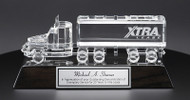
Public, specific recognition tied to a behavior or milestone. Tangible artifacts of achievement (something to take home, something visible to peers). Tenure milestones celebrated publicly, not just at 25 years but at 5, 10, and 15. Recognition frequent enough to feel routine, not corporate. And recognition that comes from someone the driver actually respects (manager, owner), not from "the company" abstractly. The crystal recognition pieces we build are designed to do exactly this work: named, dated, presented in person, kept visible.
The Driver's Calculus, in Two Scenarios
Scenario A. Cash bonus only:
- Bonus deposited
- Taxed
- Spent
- Forgotten by month 6
Scenario B. Recognition program:
A crystal million-mile award presented in person, with their name and date on it. Goes on the mantel at home. Grandkids see it for 20 years. Their wife mentions it to her sister when someone asks about her husband's work. Their next prospective employer notices it during the home interview. Their current employer reinforces it every time they walk into the dispatch office and see the perpetual wall of monthly awards.
You can tax the first one. You can't tax the second one. You can spend the first one. You can't lose the second one.
The Hybrid Model: Nothing Here Argues for Killing Cash
Sign-on bonuses solve a specific problem: getting drivers in the door fast in a competitive recruiting market. Performance bonuses tied to specific, time-bound metrics work for a specific window. The research doesn't argue that these have zero value.
The research argues that cash without recognition is the weakest possible structure.
The strongest retention program runs both.
- Cash bonuses tied to clear, narrow metrics and milestones.
- Recognition tied to people, behavior, tenure, and achievement.
- Public moments for the recognition (driver-of-the-quarter announcements, million-mile celebrations attended by leadership, safe driving awards presented in person).
If you're forced to choose between the two, and most fleets implicitly are, because budgets are constrained, the research is unambiguous. Recognition wins on retention. Cash wins on attention.
If your retention budget is 95% cash and 5% recognition, you've inverted the data.
What This Looks Like at ASAP
We've been hand-building recognition awards for trucking fleets, 3PLs, and warehouse operations for 44 years from our St. Louis factory. The truck driver awards and crystal recognition pieces we build are designed for the moments the research above describes: public, tangible, named, dated. They don't end up in drawers. That's not marketing language. It's a craftsmanship requirement, and it's why we're factory-direct rather than reselling imported glass like most of the category. For warehouse operations and 3PLs, the same logic drives our forklift driver awards and perpetual monthly displays.
Three generations. Women-owned. Hand-built in St. Louis since 1981.
Closing
The industry has been throwing more money at driver retention for over a decade. Turnover at large carriers hasn't meaningfully improved. The research (McKinsey, Gallup, Aberdeen, Workhuman, Harvard Business Review) has been telling us why for years.
We've ignored it because the alternative sounds soft, and because the people who get the budget approved are CFOs, and CFOs are trained to evaluate line items by their precision, not their effectiveness.
It's time to look at what the research actually says. And then look at what your fleet actually does.
The gap is the opportunity.
ABOUT ASAP AWARDS
Since 1981, ASAP Awards has hand-built custom recognition awards for trucking fleets, 3PLs, and warehouse operations, from our women-owned, family-run factory in St. Louis, Missouri. Three generations. Factory-direct. No imported glass, no resold catalogs. Truck driver awards, forklift driver awards, million-mile recognition, years-of-service plaques, and perpetual monthly displays, built so the drivers who receive them don't put them in a drawer.
Explore our corporate recognition programs or call us directly at (636) 537-1517.