

Frequency vs. Magnitude
Posted by ASAP Awards on 3rd Aug 2026
Most corporate recognition programs are built around a few big moments per year. The annual awards dinner. The 25-year service banquet. The President's Club trip. The architecture is: rare, large, expensive moments. The data says this is structurally backwards.
HR Cloud's analysis of recent engagement research found that employees recognized weekly are 2.7 times more likely to be highly engaged than employees who aren't. Recognition's retention impact is more about cadence than ceremony. A small Friday acknowledgment, repeated 50 times a year, outperforms one $5,000 gala almost every time.
The Spaced Repetition of Motivation
Behavioral psychology has a name for what's happening here: spaced repetition. The brain consolidates information and reinforces motivation more effectively when stimuli arrive at distributed intervals than when they arrive in a single concentrated burst. This is why students who study for two hours a week for twelve weeks outperform students who cram for twenty-four hours in one weekend. The total time investment is identical. The retention curve is not.
The same principle applies to recognition. An employee who receives ten small acknowledgments distributed across the year has been reminded ten times that their work matters and that someone noticed. An employee who receives one large acknowledgment at the annual dinner has been reminded once, with the boost decaying steadily for the eleven months that follow.
Behavioral economists call this hedonic adaptation. The motivational lift from any single event fades within months. The size of the event matters less than its repetition. A larger event produces a larger initial spike but the decay curve is roughly the same. By month six, the $5,000 annual award and the dozen $400 monthly acknowledgments produce dramatically different cumulative effects on engagement, and the monthly cadence wins.
Why Most Programs Get This Backwards
If the research is this clear, why do most companies still architect recognition around rare, large events? Two reasons, and both are about budget visibility rather than retention effectiveness.
First, leadership-visible programs survive budgeting. The annual awards dinner is something the CEO can see. The CFO can defend the line item with a single event on the calendar. The board hears about it during the quarterly people review. The program's existence is legible to everyone whose approval matters for next year's funding.
Quiet cumulative programs are not legible the same way. Fifty $400 Friday acknowledgments across the year don't show up as 'the recognition program.' They show up as fragmented line items in fifty different budget periods, with no central event for leadership to recognize. The program does more retention work but it's invisible to the people who decide whether to fund it next year.
Second, the annual event feels like a complete answer. 'We have a recognition program' becomes 'we have an annual dinner.' The cognitive shortcut closes the question. Companies stop asking whether they have a recognition program because they've already produced an event that visibly looks like one. The actual retention math goes uninspected.
What a High-Frequency Program Actually Looks Like
The structure that delivers the 2.7x engagement multiplier isn't complicated. It's deliberate.
Weekly: Manager acknowledgment of specific behaviors. Not generic praise. Specific recognition tied to specific actions, delivered within the same week the behavior occurred. This is a manager habit, not a program line item, but it requires manager training and accountability to actually happen consistently. Most managers don't do this without prompting.
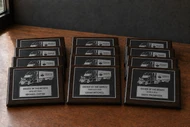
Monthly: Driver-of-the-month, safety-leader-of-the-month, or equivalent. This is where the perpetual monthly award display becomes operational infrastructure. Twelve plates per year, accumulating on the dispatch office wall, naming the recognized employee and the month. The cost is modest, the visibility is high, and the cumulative effect is exactly what the frequency research predicts. Every new driver who walks past the wall sees a year of recognized peers and asks the question that starts retention: 'How do I get on this wall?'
Quarterly: Performance and safety recognition with crystal awards or substantial custom plaques. Presented in person, by leadership, in front of peers. Larger than the monthly recognition, smaller and more frequent than the annual event. The quarterly cadence keeps the cumulative effect compounding.
Annually: Top-tier recognition for the year's standout contributions. This is where the dinner or banquet still has a place, but it's the capstone of an already-recognized year, not the totality of the recognition program. Employees walk into the annual event having been recognized monthly and quarterly. The annual moment reinforces, not initiates.
The Budget Reallocation Argument
If your current recognition budget is allocated mostly to one or two large annual events, the math wants you to redistribute. The same dollar amount delivered weekly, monthly, and quarterly outperforms the same dollar amount concentrated in a single event. The total spend can stay the same. The retention impact changes substantially.
A practical reallocation example. A 100-person operation currently spending $30,000 annually on the year-end recognition dinner. The redistribution: $5,000 for the annual event (scaled down but still a moment), $12,000 for quarterly recognition pieces (four moments per year across the workforce), $9,000 for monthly perpetual displays and driver-of-the-month awards (twelve moments per year, visible all year), and $4,000 for weekly manager acknowledgment infrastructure (small awards, certificates, peer recognition tokens). Total: still $30,000. Retention impact: dramatically higher, per the research.
The harder part isn't the math. It's the politics. Leadership has emotional and political investment in the annual event. Cutting it (even partially) to fund the higher-frequency program reads as cost-cutting, even when the redistribution holds total spend constant. The companies that get this right tend to treat it as a multi-year transition rather than a single-year reallocation. Year one, add the higher-frequency program alongside the annual event. Year two, observe the impact. Year three, redistribute the funding once the data supports it internally.
Closing
Your $30,000 annual recognition dinner produces less retention impact than $30,000 distributed across 50 weeks of smaller, more frequent moments. Same budget. Different outcomes. The research has been telling us this for years. Gallup and Workhuman found that only 22 percent of employees feel they get the right amount of recognition, a figure unchanged from 2022 to 2024. The problem isn't budget. It's architecture.
Build for cadence. The ceremony can stay. Just don't let it be the whole program.
ABOUT ASAP AWARDS
Since 1981, ASAP Awards has hand-built custom recognition awards for trucking fleets, 3PLs, manufacturing operations, and corporate teams, from our women-owned, family-run factory in St. Louis, Missouri. Three generations. Factory-direct. No imported glass, no resold catalogs. Truck driver awards, forklift driver awards, years-of-service plaques, crystal recognition pieces, and perpetual monthly displays, built so the people who receive them don't put them in a drawer.
Explore our corporate recognition programs or call us at (636) 537-1517.