


Recognition as Operating System
Posted by ASAP Awards on 8th Sep 2026
After twelve weeks of arguing that recognition is the highest-ROI retention lever in the operations and HR budget, the question becomes operational. How do you run it so it doesn't depend on constant executive attention, doesn't disappear when a leader transitions, and produces compounding retention impact across years rather than diminishing campaigns?
The answer is recognition as operating system. Not as program. Not as campaign. As OS. The distinction matters more than it sounds.
The Difference Between a Program and an Operating System
A program is something you run. An operating system is something that runs.
A program needs continuous attention to function. Someone has to decide what to do next, when to do it, how to budget for it, and whether to keep doing it. The program lives in the head of whoever's running it. When that person leaves or gets distracted, the program degrades.
An operating system needs initial design effort and ongoing minor maintenance, but it runs without continuous attention. The triggers are automatic. The decisions are pre-made. The infrastructure persists. The system produces the output reliably whether the original designer is in the room or not.
Most companies have recognition programs. Almost no companies have recognition operating systems. The companies that do tend to have unusually flat tenure curves and unusually high retention across leadership transitions. The pattern is observable enough that you can usually predict which type a company has by walking through their dispatch office or manufacturing floor for ten minutes.
The Four Layers of a Recognition Operating System
If you've followed this series, you've already seen the components. Putting them into a system is what week 12 is about.
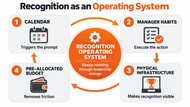
Layer 1: The Calendar. Calendar-triggered events that don't require anyone to remember. Anniversary dates auto-flag 30 days in advance. Monthly award decisions sit on the calendar with assigned decision-makers and deadlines. Quarterly recognition events have fixed dates a year in advance. The calendar is the heartbeat. If a leader transitions, the calendar keeps generating prompts.
Layer 2: The Manager Habits. Recognition built into the manager's weekly operational rhythm. Weekly 1-on-1 templates include a recognition prompt. Monthly award nomination is a standing agenda item in operations meetings. Quarterly stay-interview conversations are scheduled and tracked. The behaviors are documented in the manager's toolkit, not held in cultural memory. New managers inherit the same rhythm without having to invent it.
Layer 3: The Physical Infrastructure. Perpetual award displays in operational areas. Tenure milestone plaques mounted permanently in high-visibility locations. Crystal award trophy cases in lobbies or dispatch offices. The infrastructure persists through leadership cycles, software platform changes, and budget reorganizations. It accumulates recognition data visibly and produces ambient recognition pressure without anyone having to drive it.
Layer 4: The Pre-Allocated Budget. Recognition budget built into operational and departmental P&Ls, not into HR strategic line items. Each manager has a pre-allocated quarterly recognition spend. Friction at the point of recognition is zero, because the spending authority and the budget are already in place. Recognition decisions don't require permission requests, because permission has been pre-granted.
How These Four Layers Interact
The interaction is what produces the compounding. Any single layer in isolation is weaker than the system.
The calendar without manager habits produces prompts that don't get acted on. The manager habits without the calendar produce inconsistent execution. The physical infrastructure without budget produces walls that don't get updated. The budget without the calendar produces unspent allocations that get clawed back at year-end.
Together, the four layers produce a system where the calendar triggers the prompt, the manager habit executes the action, the physical infrastructure makes the recognition visible and durable, and the pre-allocated budget removes the friction. Each layer reinforces the others. The cumulative effect compounds across years, leadership transitions, and budget cycles in a way that no individual program element can match.
What Implementation Looks Like
If you're building this from scratch, the order matters.
Start with Layer 3, the physical infrastructure. It's the most durable layer and the hardest to undo once installed. Put up the perpetual monthly award display in the dispatch office, the warehouse breakroom, or the manufacturing floor. Mount the tenure milestone wall. Install the trophy case if appropriate. The infrastructure creates demand for its own continuation. Once the wall is there, the wall needs to be filled, and filling it becomes the system's first ongoing requirement.
Then build Layer 4, the pre-allocated budget. Move recognition spending from HR's strategic line items into operational and departmental budgets. Give each operational manager a quarterly recognition allocation. The budget structure determines what's actually defensible in next year's planning cycle.
Then build Layer 1, the calendar. Calendar-triggered events. Anniversary auto-flags. Monthly award decision deadlines. Quarterly presentation dates set a year in advance. The calendar becomes the system's clock.
Finally build Layer 2, the manager habits. This is the slowest layer because it's about behavior change, not infrastructure or process. But once the other three layers are in place, the manager habits build themselves over time, because the calendar is generating prompts, the budget is available, and the infrastructure is waiting to be filled.
The Closing Reframe of the Entire Series
This 12-week series started with the engagement survey lie and ended with recognition as operating system. The arc was deliberate. Every post built toward this synthesis.
Engagement surveys produce data that looks fine while retention craters underneath. The 90-day cliff loses 43 percent of new hires before recognition programs even acknowledge them. Stay interviews are the conversation almost nobody is having until it's too late. What employees say they want isn't what actually keeps them. Managers are 70 percent of engagement variance and almost no manager development program targets the specific behaviors that move retention. Public recognition outperforms cash because status motivation is older and deeper than financial motivation. Frequency beats magnitude. Peer recognition compounds in ways top-down recognition doesn't. Service anniversaries are the cheapest retention moments on the calendar and almost everyone fumbles them. Most programs don't survive leadership change because they're tied to executive sponsorship instead of architectural durability. Frontline workers receive a fraction of the recognition office workers do, inside the same companies, with the same nominal programs.
Each of those is a piece of the puzzle. Putting them together into a system that runs is what this final post is about. Calendar. Manager habits. Physical infrastructure. Pre-allocated budget. Four layers, reinforcing each other, producing recognition cadence that survives leadership change and produces compounding retention impact across years.
The first version of your operating system doesn't have to be perfect. It has to be durable. Companies that get this right don't have the best recognition programs. They have recognition programs that still exist three years from now. The companies that don't, rebuild every 18 to 36 months from scratch and never get the compounding benefit.
This Is Why We Build What We Build
We've been hand-building recognition awards from our St. Louis factory since 1981. Three generations, women-owned and family-run. The reason we're still around 44 years later is that we built the kind of physical recognition infrastructure that fits into Layer 3 of an actual recognition operating system. Our pieces sit on customer walls, in dispatch offices, in warehouse breakrooms, on home mantels, for decades. They do retention work every day they're displayed.
If you're ready to build a recognition operating system for your operation, we'd be glad to talk it through. Truck driver awards. Forklift driver awards. Years-of-service plaques. Crystal recognition pieces. Perpetual monthly displays. Corporate recognition programs. All hand-built, all factory-direct, all designed to do retention work for decades. Call (636) 537-1517.