



Recognition That Survives Leadership Change
Posted by ASAP Awards on 24th Aug 2026
Recognition That Survives Leadership Change
One of the most under-discussed reasons recognition programs fail isn't strategic, financial, or cultural. It's organizational. A new VP of HR comes in, signals their vision by retiring the predecessor's programs, and the recognition cadence employees relied on for years just disappears. The retention impact is brutal, and it's almost always invisible to the new leadership, who has no reference point for what was lost.
This is the failure mode most recognition vendors don't tell you about. The program isn't fragile because the design was bad. It's fragile because the design was tied to the person who built it.
The 18 to 36 Month Half-Life Problem
Most executive-sponsored recognition programs have an observed half-life of about 18 to 36 months. The pattern is consistent enough that you can see it across industries.
Year one: launch. New executive sponsor pushes the program through, secures budget, drives adoption. Adoption climbs through the year.
Year two: peak. The program is running well, recognition is happening at the designed cadence, employees know what to expect.
Year three: the sponsor transitions. New role, new company, new priorities. The replacement comes in. The replacement either inherits the program quietly (rare) or signals their new vision by introducing different priorities (common).
Year four: the program quietly retires. Budget gets redirected. Managers stop receiving prompts. The perpetual displays stop getting updated. The recognition cadence breaks. Employees notice. They don't always complain, because complaining about lost recognition feels small. They just become less engaged, and a year or two later, more of them leave.
The retention impact of this cycle is enormous and largely invisible. It doesn't show up in the new HR leader's first-year metrics, because turnover lags engagement by 12 to 24 months. By the time the data catches up, the cause has been forgotten.
The Architectural Difference Between Fragile and Durable
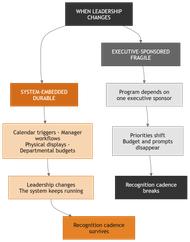
Programs that survive leadership transitions tend to share four architectural features. None of them are about program quality. They're about who depends on whom.
- Calendar-triggered, not memory-triggered. Anniversaries, monthly milestone deadlines, quarterly review points, holiday recognition moments. Triggered by dates in the calendar, not by anyone remembering to do something. If a new HR leader stops driving the program, the calendar keeps generating the prompts.
- Manager-executed, not executive-sponsored. The recognition happens in the operational rhythm of the manager's week, not in the strategic planning of the executive. Weekly 1-on-1 templates include recognition prompts. Monthly award decisions sit on the manager's calendar. The program runs through the manager layer, which is the only layer that survives every leadership transition above it.
- Physical infrastructure embedded in the workplace. A perpetual award display on the wall doesn't get retired in a budget meeting. It's already paid for. It's already installed. New plaques continue to be ordered because the wall has empty plates that need filling. The infrastructure creates demand for its own continuation.
- Pre-allocated budget at the operational level. The recognition budget is built into operations or departmental budgets, not into the HR strategic line item. Each manager has a pre-allocated quarterly recognition spend. The budget can't get redirected in a new HR leader's strategy review because it's not in HR's budget to redirect.
Why Physical Infrastructure Is Underrated Here
There's a structural reason perpetual monthly displays and permanent plaque installations survive leadership transitions where digital recognition platforms don't. They're already in the building.
A digital recognition platform requires an annual contract renewal. The renewal is a budget decision. The budget decision goes through the new HR leader. The new HR leader may have other priorities. The platform doesn't get renewed, and the recognition program disappears with it.
A perpetual wall display has no renewal decision. The wall is installed. The plates accumulate. The only ongoing cost is the marginal cost of new plates as months go by, which is small enough to not appear in strategic budget reviews. The infrastructure persists through leadership cycles that kill software-dependent programs.
This is one of the unspoken durability advantages of tangible recognition infrastructure over digital alternatives. The physical objects continue producing recognition signals long after the executive who initiated the program has moved on. The cumulative retention impact compounds across leadership transitions that would have ended a software-driven program.
The Next CEO Test
Here's a useful frame for evaluating whether your current recognition program will survive.
Imagine your CEO leaves tomorrow. The new CEO comes in, conducts a 90-day review, and reorganizes priorities. Your recognition program is up for review. The CEO has no historical attachment to it, no relationship with the people who built it, and no reason to defend it specifically.
Which parts of your current program survive this review?
Programs tied to executive sponsorship: unlikely to survive. Programs built into manager workflows and operational calendars: likely to survive, because they're not visible enough at the executive level to get killed in a top-down review. Programs with physical infrastructure already installed: definitely survive, because removing them costs more than maintaining them. Programs with pre-allocated departmental budgets: likely to survive, because the budget isn't in HR's line item to be redirected.
If the answer to 'what survives?' is 'nothing,' you don't have a recognition program. You have an executive's initiative. The two are different. The first builds retention compounding. The second produces retention turbulence every time leadership changes.
How to Build Durability Now
If you're starting a new program, build durability in from day one. Calendar-triggered events. Manager-executed cadence. Physical infrastructure as the backbone. Pre-allocated operational budget. The program should be designed to not need its sponsor.
If you're inheriting an existing program from a predecessor, the most retention-protective thing you can do in your first year is to NOT change it. Audit it, understand it, observe how managers use it. Identify the physical infrastructure components that are working and make sure their budget is protected. The temptation to put your stamp on the program is real and almost always counterproductive.
If you're an executive considering changes to a working recognition program, the question to ask first is: 'What's the retention cost of disrupting this?' Not 'how can I improve it?' Improvement is the wrong frame for inherited programs that are working. Continuity is the frame. Improvement should be reserved for adding to the program, not restructuring what's already there.
Closing
Your recognition program will outlive your VP of HR. Or it won't. Most don't. The difference between the programs that survive and the programs that don't isn't quality. It's architecture.
Build it into the operational rhythm. Anchor it in physical infrastructure. Pre-allocate the budget. Distribute the execution to the manager layer. Design it so the program doesn't need any specific person to exist.
The next CEO test is the right test. Your program should pass it.
ABOUT ASAP AWARDS
Since 1981, ASAP Awards has hand-built custom recognition awards for trucking fleets, 3PLs, manufacturing operations, and corporate teams, from our women-owned, family-run factory in St. Louis, Missouri. Three generations. Factory-direct. No imported glass, no resold catalogs. Truck driver awards, forklift driver awards, years-of-service plaques, crystal recognition pieces, and perpetual monthly displays, built so the people who receive them don't put them in a drawer.
Explore our corporate recognition programs or call us at (636) 537-1517.