


Stay Interviews vs. Exit Interviews
Posted by ASAP Awards on 6th Jul 2026
Stay Interviews vs. Exit Interviews
The exit interview is a postmortem. By definition, it's too late. The patient is already gone. The conversation that would have actually retained the employee, the one that asks what would keep them, is the conversation almost nobody has.
This is the most preventable mistake in modern HR, and the data on it is brutal.
Gallup research found that 36 percent of leavers never talk to anyone before deciding to resign. Forty-five percent report no effort was made to discuss their job satisfaction, performance, or future with the organization in the three months before their resignation. Even when leavers did talk to managers, only 17 percent were asked what it would take to keep them.
Read that paragraph twice. The industry has built rigorous machinery to study departing employees and almost nothing to listen to current ones. Then it acts surprised when retention falls apart.
Why Stay Interviews Aren't Happening
Three reasons, and none of them are insurmountable.
First, the conversation feels uncomfortable. Asking an employee 'what would keep you here?' can land as a confrontation if the relationship isn't strong. Most managers haven't been trained on how to start the conversation, what to listen for, or what to do with the answers. So they don't start it at all.
Second, there's no organizational protocol. Exit interviews are systematized. HR sends a calendar invite, the exit interview happens, the results get logged. Stay interviews require a manager to initiate something that isn't on the company calendar, with no template, no follow-through expectation, and no accountability if they skip it.
Third, follow-through is the harder problem. If a stay interview reveals something fixable (the employee wants more recognition, more clarity, more flexibility), someone has to actually fix it. Without commitment to act on the answers, the conversation makes things worse, not better. Many managers correctly intuit this and avoid the conversation rather than have it and disappoint.
The Five Questions That Actually Work
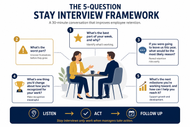
If you do nothing else as a manager this quarter, schedule a 30-minute stay interview with every direct report. Ask these five questions. Listen more than you talk.
- What's the best part of your week here, and why? Opens the conversation with an easy answer. Tells you what's working. Often produces an answer the manager didn't expect, which is the point. You can't reinforce what you don't know is working.
- What's the worst part? The hard question delivered conversationally. Most employees won't volunteer this without being asked directly. The answer is usually specific (one process, one peer, one recurring issue) and often fixable.
- If you were going to leave us this year, what would be the most likely reason? This is the validated retention predictor research has identified. Phrased this way, it's a hypothetical, which lowers the stakes. The answer is usually honest, and the answer is what to address before it becomes a resignation.
- What's one thing you'd change about how you're recognized for your work? The recognition question, asked directly. Most managers learn from this that they're recognizing the wrong things, or not often enough, or in the wrong way. The answers are usually granular and immediately actionable.
- What's the next milestone you're working toward, and how can I help you reach it? The growth question. Reframes the conversation toward the future. Tells you whether the employee can articulate their own next milestone, and signals that you're invested in helping them get there.
What to Do With the Answers
Documented stay interview programs have reduced turnover by 24 to 50 percent in case studies. But only when the answers get acted on. The conversation without follow-through is worse than no conversation at all.
Three rules for the follow-through:
- Within 7 days of every stay interview, take one specific action based on what you heard. Not a project. One action. A schedule change, a public acknowledgment, a one-line email to the employee that says 'I heard you on X, here's what I'm doing about it.'
- Within 30 days, follow up with the employee on the action. Closing the loop is the difference between a conversation that builds trust and one that erodes it.
- Track the data. Every stay interview should produce a one-line note for the manager's records. Patterns emerge quickly across a team. Patterns are where retention strategy lives.
The Recognition Connection
Stay interviews are easier to conduct in environments where recognition is already happening. A manager who has presented a quarterly recognition award has the relationship to ask 'what would keep you here long-term?' A manager who has never recognized the employee asking that question reads as desperate or as setting up for a layoff conversation.
The companies running effective stay interview programs almost always also have visible recognition infrastructure (the perpetual displays, the years-of-service plaques, the safe driver crystal awards) that gives managers credibility when they sit down for the conversation. The recognition is the relational scaffold the stay interview is built on.
Closing
By the time you're conducting the exit interview, you've already lost the conversation that mattered. Gallup's data is unambiguous: 50 percent of American employees are watching for or actively seeking new jobs at any given moment. If you're not having the conversation that asks why they would stay, someone else is having the conversation that asks why they would leave.
The exit interview tells you what failed. The stay interview tells you what to fix. The first is cheap to run and produces no retention. The second is cheap to run and produces measurable retention. The math is obvious. Almost no company is doing it.
ABOUT ASAP AWARDS
Since 1981, ASAP Awards has hand-built custom recognition awards for trucking fleets, 3PLs, manufacturing operations, and corporate teams, from our women-owned, family-run factory in St. Louis, Missouri. Three generations. Factory-direct. No imported glass, no resold catalogs. Truck driver awards, forklift driver awards, years-of-service plaques, crystal recognition pieces, and perpetual monthly displays, built so the people who receive them don't put them in a drawer.
Explore our corporate recognition programs or call us at (636) 537-1517