



The Math on Driver Turnover Nobody Wants to Show the CFO
Posted by ASAP Awards on 1st Jun 2026
The Math on Driver Turnover Nobody Wants to Show the CFO
Most operations directors know driver turnover is expensive. Most can't tell you what it actually costs. The few who can usually understate it, because the real number is hard to defend in a budget meeting, and the cheaper number is what got the budget approved in the first place.
Let's run the math nobody wants to run.
The Numbers Everyone (in Research) Agrees On
- Upper Great Plains Transportation Institute, the most-cited industry study on this, pegs the average cost at $8,234 per driver, with a documented range from $2,243 to $20,729.
- AvatarFleet's working number is roughly $12,000 per driver. BLS estimates run up to $20,000.
- PDA's 2024 driver turnover snapshot put the cost at $12,799 per driver lost in 2024.
- Industry consensus settles in the $8,000 to $15,000 range for most truckload fleets.
The studies also note something the industry often glosses over: the cost of turnover per truck driver is roughly 3x the average cost of turnover for general U.S. employees. Trucking has one of the most expensive labor turnover problems in the country.
What Goes Into the Number
The cost isn't a single line item, which is exactly why most fleets understate it. The components include:
- Recruitment advertising and recruiter time (internal or external)
- Driver orientation and onboarding
- Background checks, drug testing, DOT physical, MVR pulls, road test
- Equipment idle time during the vacancy gap
- Lost revenue from an unmanned truck
- Productivity loss as a new driver ramps to baseline (3 to 6 months)
- Administrative time across HR, payroll, ELD provisioning, insurance setup
What Rarely Goes In the Number (But Should)
- Insurance impact. New and inexperienced drivers carry higher accident rates.
- Safety event probability during the learning curve on unfamiliar routes.
- Customer-facing disruption. Missed delivery windows during the vacancy.
- Manager and dispatcher time spent supporting the new hire.
- Compounding cost. Drivers who quit early often demoralize others who were on the fence.
Now Apply It to Your Fleet
Use a conservative middle estimate of $10,000 per replacement (lower than PDA's 2024 number, midpoint of the consensus range).
100-truck fleet at 80% annual turnover: 80 replacements × $10,000 = $800,000 per year. Bleeding through HR, ops, insurance, and accounting line items that mostly don't get tagged as "turnover cost."
50-truck fleet at 80% turnover: $400,000 per year.
500-truck fleet at 80% turnover: $4 million per year.
These are the numbers the industry has agreed to live with.
The Contrarian Punch
Now compare against the cost of a complete recognition program for the same fleet. A 100-truck fleet runs roughly 80 to 120 awards a year across the categories that actually matter: safe driver crystal awards, years-of-service plaque milestones, million-mile achievements, and perpetual driver-of-the-month displays. Even at premium custom-built pricing in the $100 to $300 range per award, that's $15,000 to $30,000 annually. Less than the cost of replacing one to three drivers.
Now do the ROI math.
If a recognition program reduces turnover by just 10%: $800,000 baseline × 10% = $80,000 saved. Program cost = $20,000. Net ROI: 300%.
At the 31% reduction Aberdeen Group documents for effective recognition programs: $248,000 saved on a $20,000 spend. Net ROI: 1,140%.
That's not a retention program. That's an arbitrage.
Why Doesn't the Industry Treat It That Way?
Two reasons, and they're both structural.
First, the cost of turnover is fragmented across line items. HR books the recruiting. Ops books the downtime. Insurance books the premium impact. Productivity loss never gets booked anywhere. No single department has the full number visible. So nobody fights for the budget to fix it.
Second, recognition programs sound soft to a CFO. "We need $20,000 for plaques" doesn't pass the sniff test in a budget meeting. "We need $20,000 to capture documented 3x to 10x ROI on retention spend" does. But nobody frames it that way, because the people who pitch recognition programs usually pitch them as recognition, not as financial engineering.
The CFO Move
If you're an operations director or HR lead trying to get a recognition program funded, stop pitching it as recognition. Pitch it as turnover-cost arbitrage. Build the spreadsheet. Use the conservative numbers. Pull the Upper Great Plains Transportation Institute study. Cite the Aberdeen Group findings. Compare the program cost line against the conservative turnover cost line. The CFO will sign it before you get to slide two. If you want to see what a full corporate recognition program actually includes, that's the page to start with.
What This Looks Like in Practice
The structure that delivers the ROI math above isn't "buy some plaques." It's a deliberate, year-round program with a few core elements.
Annual safe driver awards, presented in person, usually crystal, named and dated.
Million-mile achievement plaques, the moments that genuinely go home and stay on the mantel. These are the ones that build retention narratives across years.
Years-of-service milestones at 5, 10, 15, and 20 years. Predictable, public, something to work toward. Custom plaque awards for each tenure tier so the 15-year plaque looks meaningfully different from the 5-year one.
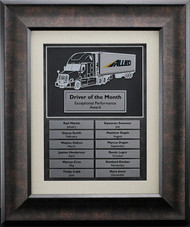
Perpetual driver-of-the-month displays in the dispatch office. These stay on the wall for years. Every new driver sees them on their first day. Every existing driver sees them every morning.
And for 3PL operations, forklift driver-of-the-month awards and forklift recognition pieces for warehouse retention. Same retention math, different equipment, same impact.
We hand-build all of these from our St. Louis factory. Three generations. Women-owned, since 1981. Factory-direct, not a reseller of imported glass, because what matters in a recognition award is that it doesn't end up in a drawer, and that's a craftsmanship problem before it's an HR problem.
Closing
Driver turnover is the most expensive line item nobody on your team owns. It's fragmented across HR, recruiting, ops, accounting, and insurance, which is exactly how it stays unfixed.
Pull the number. Run the math. Then look at how cheap the fix actually is.
The CFO doesn't need to be convinced that recognition matters. The CFO needs to see that $20,000 in awards beats $80,000 in turnover replacement costs. That math sells itself.
ABOUT ASAP AWARDS
Since 1981, ASAP Awards has hand-built custom recognition awards for trucking fleets, 3PLs, and warehouse operations, from our women-owned, family-run factory in St. Louis, Missouri. Three generations. Factory-direct. No imported glass, no resold catalogs. Truck driver awards, forklift driver awards, million-mile recognition, years-of-service plaques, and perpetual monthly displays, built so the drivers who receive them don't put them in a drawer.
Explore our corporate recognition programs or call us directly at (636) 537-1517.