


What Employees Say They Want vs. What Actually Keeps Them
Posted by ASAP Awards on 13th Jul 2026
What Employees Say They Want vs. What Actually Keeps Them
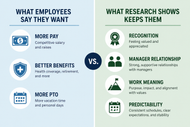
Ask employees what they want from work, they say “more pay” and “better benefits.” When you study what actually keeps them at companies, the answers are different. Sometimes dramatically different.
Gallup's State of the Global Workplace report found that engagement and culture plus well-being and work-life balance account for 69 percent of the reasons employees leave. Pay and benefits is a much smaller slice of the actual departure data. So why does almost every retention strategy still get built around what employees say in surveys, instead of what the research shows actually works in practice?
The Stated vs. Revealed Preference Problem
Behavioral economists have a term for this gap. Stated preferences are what people say they want when you ask them. Revealed preferences are what they actually do. In almost every domain (consumer purchases, voting behavior, dietary choices, career decisions), the two diverge.
Three forces collide in the workplace to make the gap especially wide.
First, employees don't always know what motivates them. Most people have never sat down and analyzed what's driving their satisfaction with a job. When asked, they reach for the most concrete, defensible answer they can articulate. Money is concrete. “I felt invisible” is harder to put into a survey response.
Second, social desirability shapes survey responses. “I left for more pay” is socially acceptable to say out loud. “I felt like the company didn't care about me” is admitting weakness. Even in anonymous surveys, the responses tilt toward what feels safe to disclose.
Third, HR programs built on stated preferences are easier to defend in a budget meeting than programs built on behavioral data. A raise the sign-on bonus, line item is easy to justify. An invest in manager training and recognition infrastructure, line item requires a longer story and more uncertain numbers. Budget meetings reward easy stories.
So the loss gets coded as pay. The fleet sharpens pencils. The retention strategy gets built on the wrong axis. And the data keeps saying something different that no one in the budget meeting wants to hear.
What the Data Actually Shows
The behavioral data on retention is more consistent than the stated-preference data, and it's been consistent for a long time.
79 percent of employees who feel valued say they're less likely to leave. Source. 84 percent of highly engaged employees plan to stay with their current employer. Same source. 67 percent of employees cite poor management, not pay, as a primary reason for leaving.
McKinsey research found that non-financial incentives (praise, leadership recognition, status acknowledgment) outperformed the three highest-rated financial incentives in their study. The most cited motivator in their data wasn't a bonus or a raise. It was praise and commendation from manager. Sixty-seven percent of employees rated it higher than performance bonuses.
Aberdeen Group's recognition program research found companies with effective recognition programs had 31 percent lower voluntary turnover than companies without them. Workhuman and Gallup joint research went further: well-recognized employees were 45 percent less likely to have turned over two years later.
None of these are pay numbers. They're not benefits numbers. They're recognition, relationship, and culture numbers. And they consistently outperform pay-based interventions on retention.
The Glassdoor Paradox
The starkest evidence of the stated vs. revealed gap is something HR teams see all the time without naming it. Call it the Glassdoor paradox. Companies with high Glassdoor scores (great place to work, would recommend) still lose employees at rates that don't match the public sentiment.
How? Because reviews are stated preferences. Resignations are revealed preferences. An employee can sincerely write a 4-star Glassdoor review on Tuesday and accept an offer from a competitor on Friday. Both are real. The Glassdoor review captured what they thought about the place. The resignation captured what they did. Those are different data sets.
Companies that build retention strategies around Glassdoor scores, internal engagement surveys, and pay benchmarking are working off the stated preference data set. Companies that build retention strategies around manager training, recognition cadences, and tenure milestone programs are working off the revealed preference data set. The second group wins. Every time.
What This Means for Your Budget
If your retention budget is structured around what employees say they want in surveys, it's almost certainly heavy on compensation and benefits adjustments and light on recognition, manager development, and tenure milestone infrastructure. The math is upside down relative to what the behavioral research suggests works.
A practical reallocation, for any organization that wants to take the data seriously: shift even 10 to 15 percent of the retention budget from compensation-adjacent line items into structured recognition. Custom plaques for tenure milestones. Crystal awards for annual safety and performance recognition. Perpetual monthly displays in dispatch offices, warehouses, and manufacturing floors so recognition is happening at the cadence the research says it should.
Recognition isn't soft. It's the most under-leveraged operational line item on most operations and HR P&Ls. The data has been clear on this for over a decade. The reason it hasn't translated into budget allocation isn't research quality. It's that survey responses are easier to defend in a budget meeting than behavioral findings, and almost everyone in the budget meeting is working from the survey responses.
Closing
When survey results and retention research disagree, follow the retention research. The survey is what people say. The research is what people do. Build your retention strategy around the second one.
Employees are not lying when they say they want more pay. They genuinely do want more pay. They will also leave for non-pay reasons that they cannot fully articulate, that they wouldn't write on a Glassdoor review, and that no survey will catch in time. Build the program for what keeps them, not for what they ask for. The two are different, and the difference is your retention strategy.
ABOUT ASAP AWARDS
Since 1981, ASAP Awards has hand-built custom recognition awards for trucking fleets, 3PLs, manufacturing operations, and corporate teams, from our women-owned, family-run factory in St. Louis, Missouri. Three generations. Factory-direct. No imported glass, no resold catalogs. Truck driver awards, forklift driver awards, years-of-service plaques, crystal recognition pieces, and perpetual monthly displays, built so the people who receive them don't put them in a drawer.
Explore our corporate recognition programs or call us at (636) 537-1517.