



Why Your Best Truck Drivers Actually Quit (It's Almost Never the Pay)
Posted by Asap Awards on 12th May 2026
Why Your Best Drivers Actually Quit (It's Almost Never the Pay)
You'll hear the same thing in nearly every driver exit interview. "Better pay across the street." It's the polite answer. It's the easy answer. It's almost never the real answer.
Industry research tells a different story. Exit surveys from PDA, Kordova, and decades of ATRI work consistently show that while compensation matters, pay alone rarely triggers the decision to leave. The real reasons cluster around four themes. And most fleets are spending money on the wrong fix.
The Four Things That Actually Push Drivers Out the Door
- Feeling like a number. Drivers spend long hours alone. They're tracked, scored, and measured. The ones who deliver consistently rarely hear about it. Industry data shows that nearly 40% of driver turnover happens within the first 90 days, exactly when the gap between "we're glad to have you" at orientation and "you're just a unit" three weeks later is at its widest. A driver who feels invisible at week six is gone by month four.
- Silence when it mattered. The driver calls dispatch about a real problem (a broken-down truck, an hours-of-service issue, a family emergency, a mistake on a settlement). The driver gets a runaround. Or worse, gets nothing. One bad communication moment during something that mattered becomes the story they tell when they take the next recruiter's call. Trust, once broken in a dispatch relationship, is rarely rebuilt.
- Pay-clarity issues (which look like pay, but aren't). When "pay" wins an exit survey, it's usually pay-clarity that broke. Settlement complexity. Unexplained deductions. Mile-pay versus hourly-pay confusion. Drivers don't only want to earn more. They want to understand what they're earning, and they want it to be predictable. PDA's 2024 turnover work found that 81.9% of job-seeking drivers were specifically looking for predictable pay. That's not a wage problem. That's a communication problem dressed up as a wage problem.
- Dispatcher and manager turnover. A driver's day-to-day relationship is with their dispatcher. When that person rotates every six months, the relationship resets, the workarounds disappear, and the trust built up over hundreds of small interactions is gone. The driver doesn't quit their company. They quit their fourth new dispatcher this year.
Why "Pay" Still Wins Every Exit Survey
If these are the real reasons, why does the exit interview keep saying "better pay"?
Three reasons, and they're all structural.
- Pay is polite. Telling your soon-to-be-former employer you felt invisible is a confrontation. Telling them you got a better number is a transaction. Most people pick the transaction.
- Pay is the only reason HR systems are built to track. Exit forms have a box for "compensation." They don't have a box for "my dispatcher never returned my calls" or "I haven't heard from leadership in a year."
- Pay is the only reason that gets budget approved. "Raise the sign-on bonus" is a defensible motion. "Build a recognition program" sounds soft to a CFO who's never run the math on what recognition actually returns.
So the loss gets coded as pay. The fleet sharpens pencils and bumps the per-mile rate. The same drivers leave again eighteen months later. For the same reasons. Coded the same way.
What Actually Moves the Retention Needle
The research has been clear for over a decade, and it's been ignored for almost as long.
- Gallup: Employees who don't receive recognition are 2x more likely to say they'll quit within the year.
- Aberdeen Group: Companies with effective recognition programs report 31% lower voluntary turnover.
- McKinsey: 67% of employees rated praise and recognition as a stronger motivator than performance bonuses. Their data shows non-financial recognition outperforming the three highest-rated financial incentives.
- Workhuman and Gallup joint research: Well-recognized employees were 45% less likely to have turned over two years later.
These aren't soft numbers from HR consultancies trying to sell something. They're from the most-cited employee research institutions in the country, published over multiple years, on samples large enough to be unambiguous.
Recognition works. Cash bonuses work less than the industry has assumed. The data has been there the whole time.
What This Looks Like in a Trucking Fleet
Recognition in a fleet doesn't mean a quarterly Zoom call with a thank-you slide. It means tangible, visible, take-it-home moments tied to specific achievements.
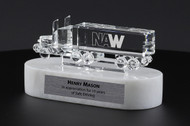
The million-mile driver award is the foundation. We've built crystal semi truck driver awards specifically for this milestone, and they go on the mantel for 20 years. The grandkids ask about them. The driver's next prospective employer hears the story.
Annual safe driver crystal awards come next. Presented in person, by leadership, with the driver's name and date engraved. Public moment. Visible to peers. The driver who gets one becomes the unofficial benchmark every newer driver looks to.
Years-of-service plaques at 5, 10, 15, and 20 years give drivers something to work toward. Milestone-based, predictable, and visibly different from the recognition a peer received last year. The 10-year plaque should look like a 10-year plaque.
And the operational backbone of any program is the perpetual monthly driver-of-the-month display. These stay on the wall in the dispatch office for years. Every new driver sees them on their first day and asks how to get on the wall. That single question, asked thousands of times across a fleet's history, is the retention conversation most fleets have never been able to start.
For 3PL operations and warehouse-heavy fleets, the same math applies to forklift operators. The forklift driver awards collection includes a forklift driver of the month plaque built for exactly this use case. Warehouse retention is a recognition problem before it's a compensation problem.
We've been hand-building these for trucking fleets and warehouse operations for 44 years out of our St. Louis factory. The pieces aren't generic plaques pulled from an importer's catalog. They're custom-built, factory-direct, designed for the moments that matter in fleet operations. See the full truck driver awards collection here.
Closing
Drivers don't quit on Monday morning. They quit on a Thursday afternoon after a dispatcher takes too long to call back about an hours-of-service issue. They take the call from the recruiter on a Friday. Their two-week notice lands the following Monday. By the time the exit survey says "better pay," the decision was made weeks ago, in a thousand small moments that had nothing to do with money.
You can't out-pay the recruiter across the street. There's always more money somewhere.
You can out-recognize them. And it costs less than one driver replacement to start.
ABOUT ASAP AWARDS
Since 1981, ASAP Awards has hand-built custom recognition awards for trucking fleets, 3PLs, and warehouse operations, from our women-owned, family-run factory in St. Louis, Missouri. Three generations. Factory-direct. No imported glass, no resold catalogs. Truck driver awards, forklift driver awards, million-mile recognition, years-of-service plaques, and perpetual monthly displays, built so the drivers who receive them don't put them in a drawer.
Explore our corporate recognition programs or call us directly at (636) 537-1517 to talk to the family that builds them.