


Your Engagement Survey Is Lying To You
Posted by ASAP Awards on 16th Jun 2026
Your Engagement Survey Is Lying To You
Most companies run engagement surveys, watch the scores tick along somewhere between 65 and 78 percent, and feel reasonably reassured. The scores look fine. Then six months later turnover spikes, a top performer walks out, an entire team announces they're leaving for a competitor, and nobody on the leadership call can explain what changed.
The disconnect isn't a coincidence. It's the design of the surveys themselves.
Gallup's most rigorous research, conducted across millions of employees over many years, puts truly engaged U.S. employees at about 21 percent. Many companies report internal engagement scores above 70 percent. That's not a small sampling difference. It's a measurement crisis hiding inside a polished slide deck that gets walked into the boardroom every quarter.
Three Reasons Your Survey Lies to You
- Generic questions produce generic agreement. Most engagement surveys ask employees to rate statements like 'I feel valued at work' on a 5-point scale. The result is a polished average score that says almost nothing about whether the employee will be here in 18 months. People hit '4' when nothing is actively on fire. The 4 doesn't predict retention. It predicts the absence of a fire that wasn't there to begin with.
The questions that actually predict retention are harder to design, harder to ask, and uncomfortable to face. Research shows that 'Do you see yourself working here in two years?' is the most validated retention predictor in the field. When scores on that single question drop below 50 percent, departure rates spike within months. Most engagement surveys don't ask it because the answer would force a leadership response nobody is ready to deliver.
- Social desirability bias is baked into every survey. When an employee fills out an engagement survey, even an 'anonymous' one, they know it lives on a company server, was sent from a company email, and gets reviewed by their HR department. People answering this kind of survey tilt toward what's socially acceptable to say. They say 'I feel respected' not because they do, but because saying otherwise feels like a workplace risk.
This is why the gap between Gallup's external research and internal company surveys is so wide. Gallup researchers can ask harder questions because the respondent isn't worried about their answer ending up in front of their manager next Tuesday. The internal survey has the wrong incentive structure baked in from the start.
- Annual surveys create a 3 to 6 month blind spot. The standard engagement survey cadence is annual. Some companies push to twice a year. By the time the results come back, get analyzed, get presented to leadership, and get translated into action items, the data is already six months old. The employee who quit two weeks before the survey was even sent shows up nowhere in the analysis.
Continuous listening through pulse surveys and behavioral signals catches disengagement before it becomes turnover. Almost no company does this rigorously. Most are still running annual sentiment surveys and using them as the primary signal.
What to Measure Instead
The companies winning on retention right now stopped scoring engagement surveys and started measuring outcomes. Deloitte research shows organizations using outcome-based engagement measures reduce voluntary turnover by 24 percent.
Outcome metrics that actually predict retention:
- Tenure curves by manager, not by company average. Most retention problems are concentrated under specific managers.
- 90-day cohort retention rates by hiring source. Which referral channels produce people who stay?
- Recognition events per employee per quarter. Count them. If the average is below four, you have a frequency problem.
- Manager 1-on-1 frequency, by manager. Below biweekly is a flashing warning light.
- Voluntary attrition broken out by tenure band. The shape of the curve tells you where to invest.
These are uncomfortable numbers to track because they expose where problems live, by name, in the org chart. Engagement survey averages protect those people. Outcome metrics don't.
The Recognition Data Hiding in Plain Sight
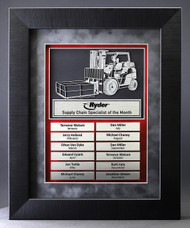
There is one engagement signal most companies already have but rarely use: how often employees are physically recognized in front of their peers. Walk into a dispatch office, a warehouse breakroom, or a manufacturing floor and look at the walls. Are there perpetual monthly award displays? Is the same wall section empty from one quarter to the next? Are there years-of-service plaques mounted prominently, or tucked into a corner nobody passes?
Physical recognition infrastructure is engagement data your team can see without running a single survey. A wall of perpetual monthly awards in active use signals a high-frequency recognition culture. The same wall sitting empty signals that recognition isn't happening at the cadence retention requires. You don't need a Gallup analyst to read this. The data is on the wall.
This is part of why we build the physical infrastructure we build, and why we've been doing it for 44 years from our St. Louis factory. Visible, hand-built, dated recognition is a form of measurement most HR teams haven't realized they have access to. The piece on the wall is the data point.
Closing
The annual engagement survey isn't useless, but it's not the retention signal it gets treated as. The 78 percent score that walks into the boardroom every quarter is mostly evidence that nothing is on fire. It's not evidence that people are staying.
Stop scoring the surveys. Start measuring outcomes. Watch the walls.
ABOUT ASAP AWARDS
Since 1981, ASAP Awards has hand-built custom recognition awards for trucking fleets, 3PLs, manufacturing operations, and corporate teams, from our women-owned, family-run factory in St. Louis, Missouri. Three generations. Factory-direct. Truck driver awards, forklift driver awards, years-of-service plaques, crystal recognition pieces, and perpetual monthly displays, built so the people who receive them don't put them in a drawer.
Explore our corporate recognition programs or call us at (636) 537-1517.