


The Frontline Recognition Gap
Posted by ASAP Awards on 1st Sep 2026
PwC's manufacturing workforce research found that only 48 percent of manufacturing leaders believe their frontline workers feel engaged. The same research showed 70 percent engagement for office-using employees. That's a 22-point gap inside the same companies, with the same compensation philosophy, often the same leadership team. The gap isn't real engagement difference. It's program design failure that doesn't reach the population it was built for.
This is the most expensive structural mistake in modern recognition design, and it's almost universal.
Why Recognition Programs Don't Reach Frontline Workers
Most recognition platforms are built for desk workers. They're email-based, software-driven, integrated with HRIS systems, and accessed through a laptop or smartphone with company credentials. The unstated assumption is that every employee has corporate email, sits at a computer, and engages with company software regularly.
Frontline workers don't match the assumption. A truck driver on a 600-mile haul doesn't have a corporate email tab open. A forklift operator on a 12-hour shift doesn't log into Slack. A warehouse picker on a metric-driven floor doesn't read company-wide newsletters during work hours. The recognition platform delivers what looks like recognition, but it doesn't reach the population it's meant to motivate.
The result is the 22-point engagement gap PwC measured. Same company, same leadership, same recognition program nominally. But the office workers receive the recognition and the frontline workers don't. The retention math diverges accordingly.
And the retention math on frontline turnover is brutal. PwC found 36 percent of manufacturers experienced frontline employee attrition rates exceeding 10 percent over a six-month period. Bureau of Labor Statistics puts retail and hospitality frontline turnover at roughly 70 percent annually. And frontline workers who feel undervalued by their managers are twice as likely to quit within their first month.
What 100 Percent of HR Professionals Already Know
PwC's research surveyed HR professionals in manufacturing about what's essential to retaining frontline workers. 100 percent of respondents said recognition and awards are essential. Not 'helpful.' Not 'a nice addition.' Essential. There is almost no other workforce intervention where HR professional agreement is this complete.
The disconnect between this universal agreement and the actual programs companies run is staggering. Every HR professional believes recognition is essential for frontline retention. Most companies run recognition programs that don't actually reach frontline workers. The belief and the implementation have completely come apart.
Why? Because the gap isn't about belief. It's about platform inheritance. The recognition program the company runs was probably built when the company was smaller, more office-centric, or led by HR talent who came up through office workforces. The platform persists. The workforce composition changed. The platform didn't.
What Actually Reaches Frontline Workers
Physical, tangible, presented-in-person recognition. This isn't a preference. It's a structural requirement of the population.
A crystal driver-of-the-quarter award presented in person by the dispatch manager reaches the driver. A Slack message congratulating the driver does not. The reasons are mechanical, not sentimental: the driver doesn't see Slack messages, doesn't have time to engage with them, and doesn't carry the recognition home in any form. The crystal piece reaches them, travels home with them, and continues producing motivational signal long after the moment ends.
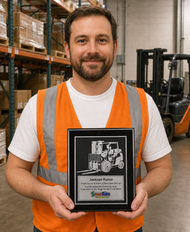
A forklift driver of the month plaque hung on the wall in the warehouse dispatch office reaches every forklift operator who walks past it every day. A monthly recognition shoutout in a company-wide email reaches none of them. The wall is the medium. The email is not.
A perpetual monthly award display accumulating names across the year, mounted in a high-traffic operational area, reaches every frontline employee who passes it every day. The display is engagement infrastructure that works without any software dependency. It doesn't require login credentials, doesn't require email access, doesn't require the employee to do anything except walk past it.
This is why physical recognition outperforms digital recognition for frontline workforces. Not because physical is intrinsically better. Because it's the only kind that actually reaches the population the recognition was built for.
The Cost Math That Should End the Debate
Frontline turnover is expensive, and the math should reorganize how recognition programs get budgeted.
Replacement cost for frontline workers runs about 40 percent of annual salary. For a 100-driver fleet with average annual driver compensation of $65,000, that's roughly $26,000 per replacement. At a 30 percent annual turnover rate (low for industry), the fleet is spending $780,000 per year on driver replacement. The math is similar for warehouse operations.
A meaningful physical recognition program for the same 100-driver fleet might cost $15,000 to $25,000 annually. Crystal driver-of-the-quarter awards, monthly perpetual displays, custom plaques for safety milestones and tenure recognition, plus the operational infrastructure to actually present them. If that recognition investment reduces turnover by even 10 percent (well within the range research suggests is achievable), the savings on replacement cost exceed the entire recognition budget several times over.
This is the math that should make recognition the easiest budget conversation HR has every year. It rarely is, because the comparison isn't being made explicitly. The recognition budget gets defended as a cultural investment. The turnover cost gets absorbed silently into operational P&L. The two never get put on the same page. Companies that spend approximately $4,700 per employee on retention programs report 87 percent higher retention and 4.2x ROI. The math is clear when it's actually run.
The Heritage Argument, Made Operational
We've built recognition pieces for trucking fleets, 3PLs, manufacturing operations, and warehouse companies from our St. Louis factory since 1981. Three generations, women-owned and family-run. The reason we've focused on frontline recognition specifically, more than corporate or executive recognition, is because the math is most lopsided here. Frontline workers are the most expensive population to lose and the least-reached population by typical recognition programs. The intervention with the highest ROI is the intervention almost no one is making correctly.
Our truck driver awards, forklift driver awards, and warehouse safety recognition pieces exist because the company that uses them solves the structural problem in this post. The piece reaches the worker. The wall display reaches every worker who walks past it. The retention math works because the recognition is actually getting delivered to the people it was meant for, not stranded in a software platform they don't open.
Closing
Your forklift operator doesn't have a corporate email account. Your truck driver doesn't read company Slack messages. Your warehouse picker doesn't engage with the HR recognition platform. The structural reach problem is real, expensive, and almost universal.
The fix is physical recognition presented in person, hung on walls workers see daily, taken home by workers who receive it. Tangible, visible, durable. This is what reaches the population that drives most of the company's operational output and bears most of the company's turnover cost.
Build the program around how the workforce actually works, not how the office workforce works. The 22-point engagement gap closes when the recognition actually reaches the people it was built for.
ABOUT ASAP AWARDS
Since 1981, ASAP Awards has hand-built custom recognition awards for trucking fleets, 3PLs, manufacturing operations, and corporate teams, from our women-owned, family-run factory in St. Louis, Missouri. Three generations. Factory-direct. No imported glass, no resold catalogs. Truck driver awards, forklift driver awards, years-of-service plaques, crystal recognition pieces, and perpetual monthly displays, built so the people who receive them don't put them in a drawer.
Explore our corporate recognition programs or call us at (636) 537-1517